



There's an old saying in Maramureș: "the forest is like a brother." Some people still say a prayer before cutting down a tree. This is how a community in northern Romania has managed to protect some of Europe's last primary and old growth forests, while building everything around them from wood. Their houses, their gates, their churches, the crosses in their graveyards are all crafted from timber. And the forests are preserved too. Maria Visovam lives alone in the village of Breb. She's elderly but fiercely independent, carrying logs for her wood-fired stove and weaving textiles on a traditional loom. Her home mirrors what happens when a community learns to take only what it needs.The secret of this place? Generations of knowledge about which trees to cut and which to leave, when to use horses instead of heavy machinery, and how to let young trees grow in the space created by their elders. Practices so ingrained that they resisted even under communist nationalization, and the value of these forests remained unchanged. In 2010, after years of work by local foresters and WWF, this approach was recognized and the forest of Maramureș received FSC certification. Today, young people are moving to the cities and traditional crafts like Teodor's roof shingles are disappearing. WWF and local communities are betting on a pilot project that aims at recognizing the forest's full value – not just for wood, but for biodiversity, natural and recreational values, and the stories it holds. In 2022, these forests became the first in Romania to receive FSC Ecosystem Services certification for recreation and biodiversity. This has opened doors to new funding for natural conservation and local employment. Sometimes innovative ideas come from the oldest wisdom. And a certification can be a way of saying: this matters. Explore the full story here.
Primary forests in Europe
One of the last bastions of preservation in Europe.
With exceptional natural and cultural values, these thriving, living environments are home to rare and threatened species. These places are our connection with a wild past, having evolved continuously over thousands of years into the complex ecosystems they are today, as well as living laboratories to study future conservation. As remnants of a much greater forest ecosystem, they are a source of scientifically important information.
Globally, primary and old growth forests play a crucial role in maintaining climate stability by storing large amounts of carbon in their plants and in soils. Furthermore, they are an irreplaceable part of our natural heritage, shaping the cultural identities of local communities and holding immense intrinsic value.
However, across Europe, primary and old growth forests represent only about 3% of the total forested area, the result of historical deforestation and long legacies of human intervention.
The European Commission’s Biodiversity Strategy for 2030 says that primary and old-growth forests should all be placed under strict protection. The problem is that, with very few exceptions, there are no clear criteria and indicators specifically tailored to national and regional needs that would allow these forests to be identified and mapped. As a result, this unique natural heritage continues even today to be irreversibly lost. Romania is one of the exceptions that has tailored local guidelines and robust legislation that can be enforced to ensure its forests can be protected.
There is a crucial need for comprehensive awareness and information about endangered primary forests, with a focus on European and national policies. Romania is a notable example that has pioneered exceptionally effective measures to protect its primary and old growth forests.
Romania
Some of the largest and most important primary and old growth forests in Europe outside Scandinavia are found in Central Eastern Europe. These forests are located mainly in the Carpathian mountain chain, which stretches from the Czech Republic through Poland, Slovakia, and Ukraine all the way to Romania and beyond.
Long before the European Commission established its objectives for forest conservation, around 340,000 hectares of primary and old growth forests had been placed under strict protection in Central Eastern Europe. This included more than 73,000 hectares in Romania, an achievement sustained through the initiative and massive support of WWF and IKEA projects .
To protect these primary and old growth forests everywhere, they need to be identified, based on specific criteria and indicators that take local conditions into account. In Romania, the process started in 2011 following a WWF campaign and is still ongoing, with the most recent publication of the National Catalogue of Virgin and Quasi-virgin Forests in 2023. The catalogue is a living document that is updated whenever new primary and old growth forests are identified that fulfill the legal designation procedure. Furthermore, to support the targets set by the EU Biodiversity Strategy—particularly the goal of placing 10% of EU land under strict protection—Romania is currently in the process of designating strictly protected areas, led by competent authorities with the support of independent experts. These areas, which include those recognized through voluntary forest certification, will need to finally include all primary and old-growth forests because they are among the most valuable habitats for biodiversity.
The primary forests across Europe according to Sabatini et al (green) almost entirely overlap with the locations of virgin and quasi virgin forests from the Romanian National Catalogue (grey). The latter shows more forests as it is continuously updated whenever new primary and old-growth forests are identified.
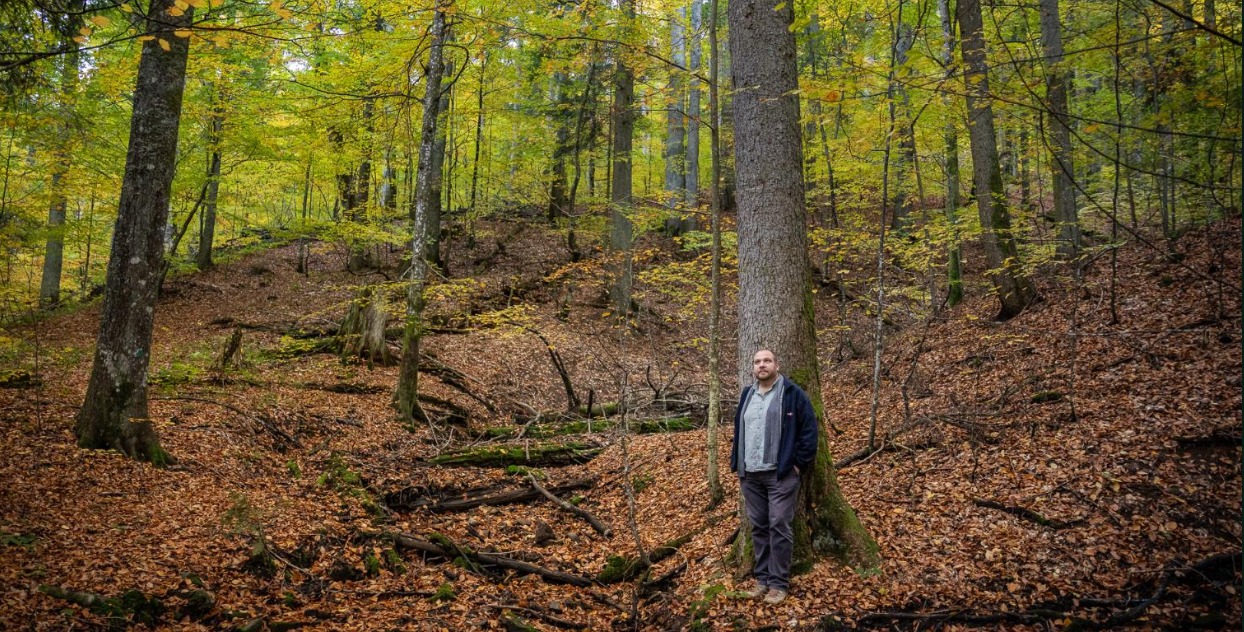
Radu, a dedicated member of WWF staff in Romania, has devoted his energy and passion to preserving the primary and old growth forests of northern Romania, where he was born and has worked for decades.
When FSC visited Maramureș in northern Romania in 2021, as we immersed ourselves in the depths of these forests, Radu shared his wealth of knowledge about how the forest functions as a living organism, trees and micro-organisms working together to maintain a stable climate within the forest.
Here among the towering beeches, with Radu as a guide, the incredible resilience within the forest became visible. Neighbouring trees are connected by a vast network of underground fungi, which transport nutrients from healthy trees to any that are wounded. Young saplings can wait for decades for a tree to fall and provide them with the sunlight they need to grow. Decaying deadwood becomes a fertile nursery for new seedlings to sprout and thrive.
During one of our trips, Radu brought along his son, who has grown up exploring the forests. It was magical to see how swiftly the young boy climbed the trees.
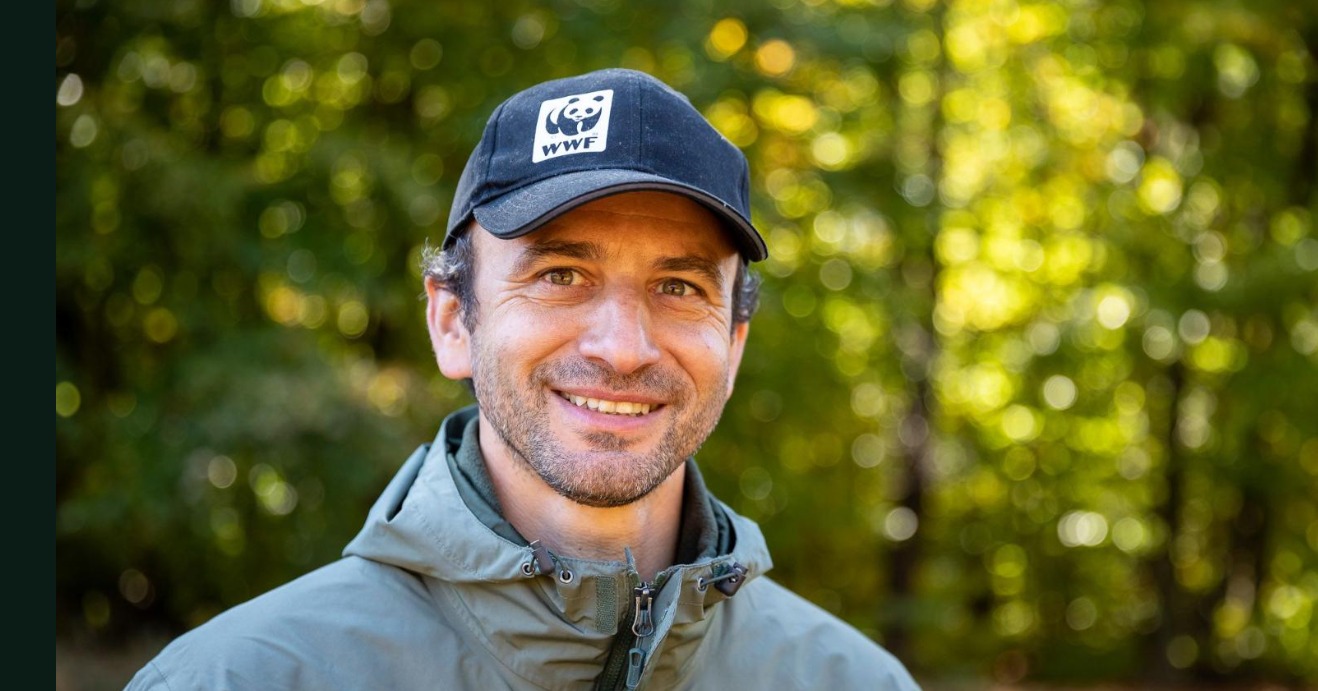
Calin also worked for WWF-Romania as an expert on forest fauna. He often spots the tracks of bear paws on the forest paths. Bears, together with wolves and lynx, are iconic species of the Carpathian forests. Their persistence is a good indicator of healthy and functional ecosystems.
Bears, together with wolves and lynx, are iconic species of the Carpathian forests. Their persistence is a guarantee for healthy and functional ecosystems. Thanks to the work of forest conservationists and game managers their numbers have thrived and their habitats have been safeguarded. More than 500 bears, over 250 wolves and 100 lynx roam in large forested areas still covering Maramureș.
Thanks to the work of forest conservationists and game managers they have thrived, and their habitats have been protected.
Romania's new National Forest Strategy (NFS) , published in 2022, marks a significant turning point in national forest policies. The strategy incorporates new conservation concepts aligned with the EU Biodiversity Strategy for 2030. In addition, it introduces a revamped system to combat illegal logging, promote responsible forest management principles, and foster a sustainable circular bioeconomy that benefits local communities, all in line with the EU Forest Strategy for 2030. The National Forest Strategy includes all WWF’s key recommendations to safeguard nature and culture and aligns closely with the FSC National Forest Stewardship Standard for Romania. It also acknowledges, for the first time, the presence of forest-dependent communities in Romania and addresses their aspirations for sustainable development.
One problem remains, that until a primary and old growth forest has been identified, mapped, and included in the National Catalogue, logging there may be legal. Additionally, there can be confusion between old-growth or old primary forest and an old managed forest where harvests to promote regeneration (and provide timber) are indeed planned and permitted. Such managed forests, which represent a significant part of Romania's forested area, are deliberately designed to achieve structures like those of old growth forests through closer-to-nature management that goes hand in hand with the multifunctional role intended for actively managed forests.
The Closer to Nature Forest Management system in Romania aims to sustain yield with management plans designed to result in what ecologists call a "shifting steady-state" landscape. This is a mosaic that contains, somewhere within the forest, all the stages of forest development. As a result, it offers good growing conditions to all species all the time. The key elements of the system are: natural regeneration following diversified silvicultural treatments, including selection, long rotations that can see 120- to 180-year-old trees as mature and ready for harvesting, coupled with a long period of tranquility or silence for the final 25-40 years of the rotation, when logging is restricted. This time is a form of rewilding, during which the stand develops the attributes of an old forest.
Despite all these important features, which create not only diverse stands but also highly diverse and balanced forest landscapes, such old managed forests are not yet in the old-growth phase. Therefore, in Romania, old-growth is used to describe forest stands that are in the last stage of their development, long after any management, as ecological communities with no significant human influences. This distinguishes them from managed stands that have a similar structure thanks to closer-to-nature forest management practices.
Civilisation built on wood
The Carpathian Mountains are home to at least half of Europe’s remaining primary forests, including the Maramureș forests in northern Romania.
Throughout history, local communities in Maramureș relied on two fundamental sources of energy: faith and forests. These pillars have shaped their philosophy of life, from tales shared in childhood to sacred places of worship. The forest and its timber are deeply intertwined with the essence of the community. The history, culture, traditions, and mindsets of these communities in the Carpathians are intricately linked to the forests that cradle them. Fundamentally, the people understand that to live, the forest must be used respectfully and sustainably.
The forest has served as a primary source of inspiration, matter, and energy for these local communities over many generations. Not surprisingly, they firmly believe that primary forests play a pivotal role in preserving their rich cultural identity.
In Maramureș, stretches of actively managed forests grow alongside areas of strictly protected primary forests, valued for their high conservation value; a principle that is deeply embedded and ingrained in the FSC standards.
Maramureș stands out as a successful example of communities using a balanced approach, strictly protecting the remaining patches of primary and old growth forests while at the same time responsibly managing the surrounding production forests. This approach aligns with the UN Convention on Biological Diversity, which highlights forest stewardship, and with the Global Biodiversity Framework, which emphasizes not only increased conservation, but also advocates for a more equitable share and sustainable use of natural resources.
This community serves as an inspiring model, showcasing how leveraging local and inherited wisdom can effectively contribute to achieving global biodiversity and climate objectives. "Strâmbu-Băiuț in Maramureș is one of the jewels of primary forests included in the National catalogue and strictly protected”. Embedded in a large, forested landscape, sustainably managed for almost a century, the old-growth heart (about 600 ha) was preserved as a witness of ancient times in the Carpathians. Its outstanding value was also recognized by UNESCO in 2017, being included in the World Heritage List under the “Primeval Beech Forests of the Carpathians and Other Regions of Europe”. To conserve this treasure, a protection buffer (of around 700 ha) was set in place in the previously managed part, making this landscape a real example of humans living harmoniously within nature.
Preserving the forest is therefore not just a duty but a deeply personal commitment to the people of Strâmbu-Băiuț, one that is woven into their everyday life. Their commitment to sustainability is ingrained within their heritage and this legacy is passed down from one generation to the next, ensuring a harmonious coexistence between the villagers and the majestic woods.
A popular saying goes: 'Romania starts where the asphalt ends'. This phrase perfectly captures the essence of Maramureș' beauty, which serves as the birthplace of omania’s villages.
In harmony with the forest
The life of the local people in the Maramureș region is closely linked to local wood, which is used to make houses, traditional gates, and many other objects of daily life. Wood also provides heat and is still used in stoves for cooking. The close connection between people and the natural resource, which has grown over centuries, means that sustainability in dealing with the forest is a matter of course. The locals have developed practices that enable them to harvest sufficient trees to meet their needs and at the same time maintain the forests in a healthy and resilient condition.
The local people have always valued their forests as part of their cultural identity. In Maramureș, there was a saying: “the forest is like a brother”. Each time they cut a tree, they said a prayer, a practice that some people continue to this day.
Even during the period of nationalization under communism, the value of the Romanian forests remained unchanged. Indeed, their importance was acknowledged as early as the 1970s. Finally, in 2010, after years of dedicated efforts of local forest administrators, foresters and WWF on the ground, the forest of Maramureș received FSC-certification.
Many houses are still built from wood as they have been since the 14 th century. Their roofs are covered with wooden tiles called shingles - thin pieces of wood nailed to the beams underneath. Making shingles requires skill and experience. It is one of the traditional crafts passed from one generation to the next, but is now slowly disappearing…It takes a lot of time to make one of these but in addition to experience, it is most important to use high-quality wood free of knots, which can only be sourced from old trees!
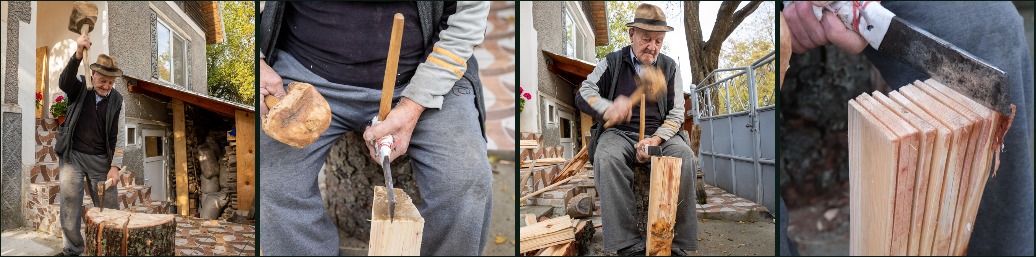 Step by step: from a slice of tree trunk to the final shingles.
Throughout his life, Teodor Ilies has been making traditional roof shingles using only hand tools. His yard is filled with stacks of fresh-cut logs and piled tree trunks, and rings with the echoes of his tireless hammering as he splits the wood to accurately create each roof shingle.
Teodor stands as one of the last guardians of this ancient practice in the village of Breb, faithfully working in this profession that only a few now pursue.
Another traditional wood-based craft in the region is the carved wooden gates. Building these renowned gates of Maramureș is a true art. They stand out as a result of their meticulous craftsmanship, distinctive sizes, and especially how they are carved with a whole iconography of local symbols that indicate richness, spirituality, and the eternity of life.
Behind the gates, the people of Maramureș are heart-warmingly welcoming, the houses and cottages they live in straight out of the pages of a fairy tale. Women in particular are the backbone of traditional practices and self-sufficiency.
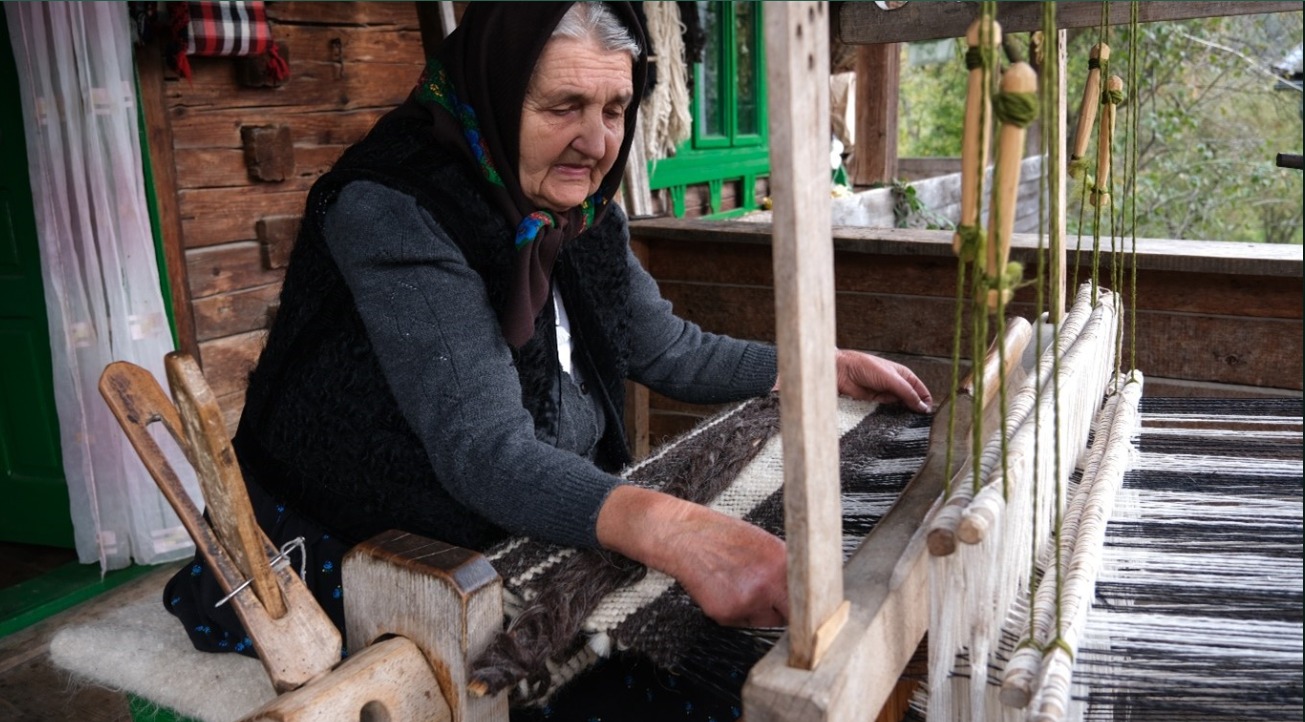
Maria Visovam, an elderly resident in the heart of Breb, is a living testament to both resilience and grace. She lives independently, navigating the tasks of daily life with unwavering strength that defies her age. Her rustic home reflects the essence of Maramureș’ interdependence with wood, from the traditional wood-fired stove she uses for cooking and warmth to the logs she carries for the fire. She crafts textiles on traditional looms, connecting to her community’s resilient heritage. Maria’s daily life reflects the harmonious coexistence between the forest’s rich offerings and the cultural heritage of her village.
Not only houses but also community buildings such as churches are made with wood.
One of them is the incredibly well-preserved UNESCO-protected Church of the Holy Archangels of Rogoz. It was constructed in 1663 using elm wood. An inscription at the entrance from the time of the church’s construction refers to the Ottoman invasion of 1661.
The current protector of this historical monument is Father Ioan Hojda, who brims with pride as he explains how the church symbolizes the deep-rooted connection between the villages of Maramureș and their forested landscapes. Every detail in the church was carved by hand and visitors arrive from around the world to witness how faith, history and craftsmanship all intertwine in this place of worship.
Even the crosses in the graveyard close the cycle of life with wood.
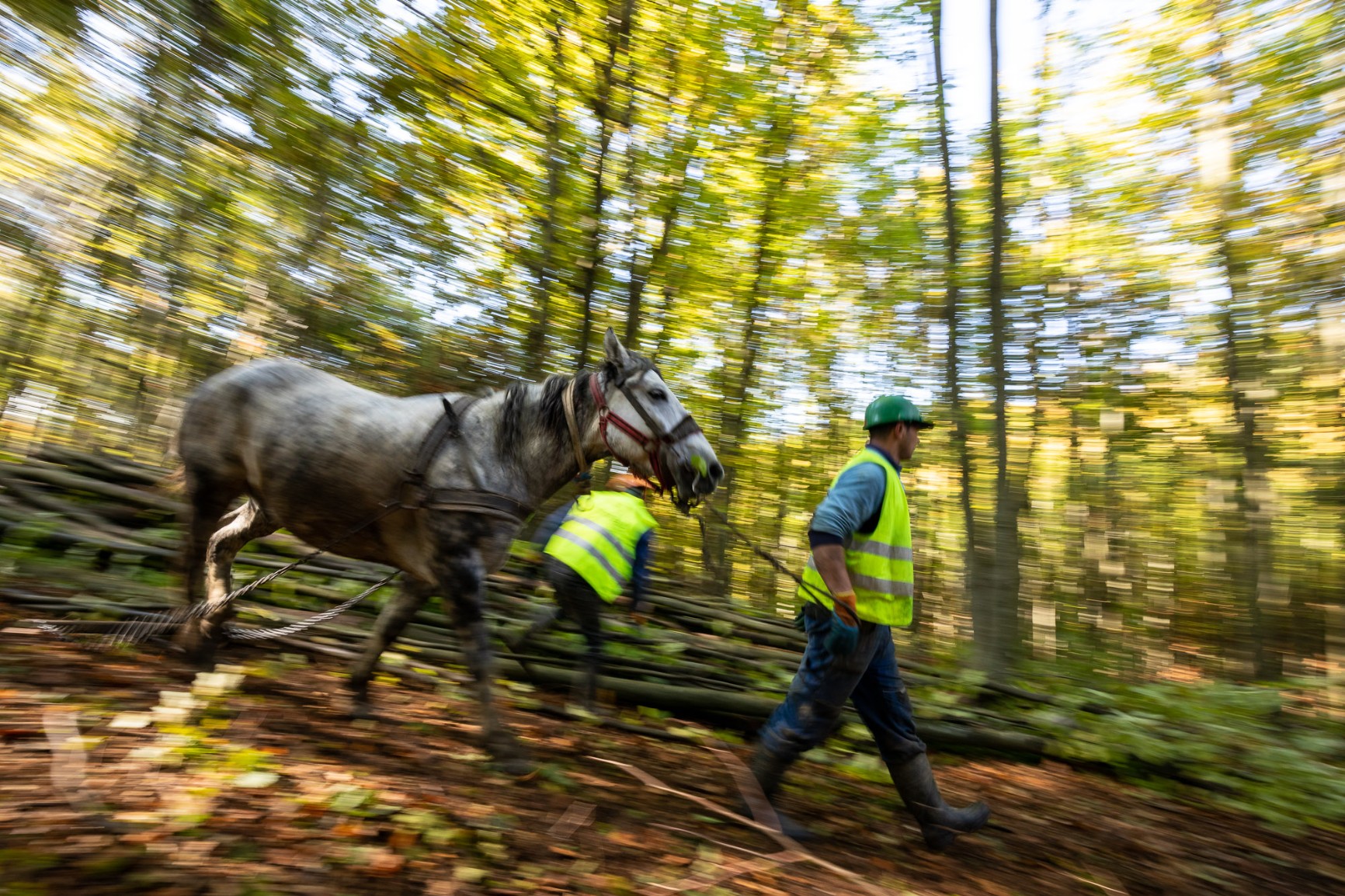
Due to the significant role that forests and wood hold in people’s lives, they learnt over years to manage them in a sustainable way. When thinning trees in a young forest, horses are used to minimize the impact of interventions on soils and other plants and animals.
Learning to manage forests sustainably was key for society as wood is an integral part of every step of life. This longstanding tradition continues, demonstrating the inherent connection between using wood and protecting forests which go hand in hand on a landscape level.
Sustainable forest management
Ten years after the start of its official protection, FSC visited the forests and villages in Maramureș, eager to see first-hand the daily forest management.
During the thinning of young forest, selected trees are carefully cut to create space for the growth of others over the coming decades, thus forming a system of roots and well-proportioned trunks that will increase the resistance and resilience of the forest ecosystem against natural hazards. Traditional techniques use horses to drag trees to the nearest road. This minimizes environmental impact and avoids the use of heavy machinery that needs large forest roads. Smaller trucks collect the stacks of wood from where the horses left them by the side of existing roads.
Although these thinnings are too small to be used for furniture or in construction, they do not go to waste. Instead, local companies transform them into valuable charcoal, adding economic value to the forest resource for local communities. Larger timber, much of it processed by an FSC-certified company called BKT Forest, does go into furniture, an important industry in Romania.
BKT Forest is happy to share details about how they document timber volumes and sales. They use the compulsory online system called SUMAL which records all timber transactions in Romania and prevents data manipulation after input. All operations are published in real-time on a single online platform that offers transparency to anyone interested. The platform tracks the entire journey of the wood, from the management plan and harvesting permit to the transport of any wood products. FSC certification streamlines the paperwork at BKT Forest to provide SUMAL with proper documentation and information for annual audits. Florin Buda, the managing director, is very proud of his FSC certificate, which represents official recognition and acknowledgment of his commitment to honest and robust forest management practices, a legacy passed down from his father. He believes such recognition is crucial for the area, providing jobs in forestry after the mining industry in the region shut down.
Despite efforts to ensure that timber is legally harvested and traceable, illegal logging is still a challenge for Strâmbu-Băiuț. With low incomes in rural areas and energy costs on the rise, wood has become a highly sought-after resource, prompting some people to obtain wood illegally. In the summer of 2024, during routine monitoring, local forest managers noticed unmarked stumps, indicating that trees had been cut without authorization. The foresters followed the internal procedures for such incidents, documented their findings, and reported them to the Forest Directorate and relevant authorities. A thorough investigation was then conducted over several months across the entire Forest Management Unit.
This investigation revealed illegal logging that amounted to approximately 500 cubic metres of wood over the past 3-4 years. The culprits were identified and sentenced, with the court’s decision pending confirmation. While these quantities represent only 0.3% of the annual allowable cut for the forest management unit, additional administrative and forest protection measures have been put in place to prevent similar incidents in the future. Unfortunately, pressure on forests continues to pose a challenge for the forestry sector; there have even been reports of attacks on forest rangers.
The future of forests
Maramureș is a region on the cusp of change. Young people have been leaving for the cities and traditional values are threatened. A modern spark of entrepreneurial spirit is needed to bring people and investment back. But this has to happen in a sustainable way so that communities do not lose their connection to the forest on which they rely. No state or EU funds are available to support forest conservation in Romania, which means the answer will lie in ensuring that the true value of the forest is recognised for what it provides for nature and people, beyond wood.
WWF has worked on a pilot project with the Strâmbu Bãiut Forest District to strengthen the business case for sustainable forest management and to improve local opportunities. The project is grounded in recognizing the biodiversity, cultural, recreational, and natural values of the forest. Together with local stakeholders and communities, WWF is exploring payments for ecosystem services to provide additional funds for conservation and contribute to developing the ecotourism potential of this unique region.
The Forest Directorate’s forests received FSC Ecosystem Services certification in 2022 for the Recreation and Biodiversity services that the forest provides – a first for Romania. Now, a local entity of community groups, the Forest Directorate, and WWF has been set up to seek investments that will improve wildlife protection, promote human and wildlife coexistence, and also help create local employment.
As Radu says, Maramureș is the perfect testing ground for such innovative nature conservation ideas that benefit nature and people. If successful, the scheme can be scaled up and replicated to help safeguard other crucial areas of primary forest.
CALL FOR ACTION
Join FSC and WWF in their mission to protect primary forests, not just in Romania, but worldwide. Together, let us take a stand to defend these precious ecosystems from imminent threats due to insufficient protection.